



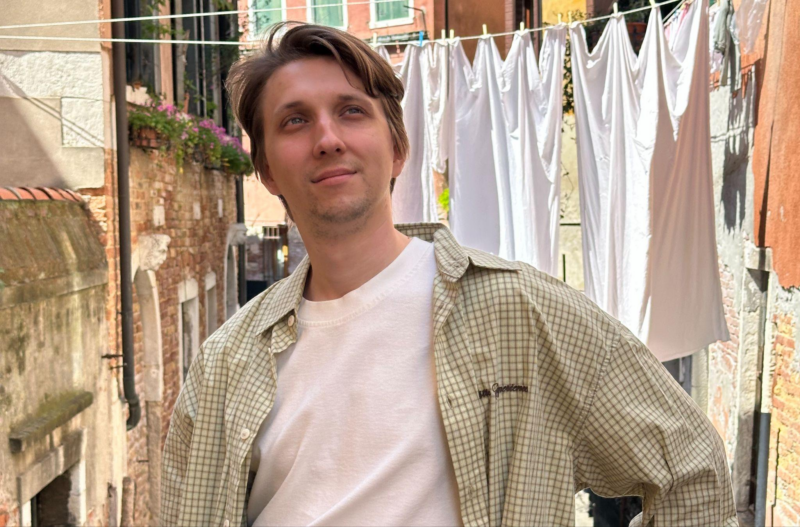
In the spring of 2023, short videos made with Filtsy, a small mobile app, were racking up millions of views on TikTok, Instagram Reels and YouTube Shorts. One of them came from Supercar Blondie.
The app overlays augmented reality effects on the camera feed while the user is still filming, and much of the engineering behind it belonged to Evgenii Zhukov, Filtsy’s technical co-founder.
Two years later, the company was out of money. Zhukov had spent nearly six years building his own startups, first Jayter and then Filtsy, both with co-founder Anton Abramov. The team had changed direction several times without finding steady demand, and by the end it could no longer pay its people.
In July 2025, Zhukov joined Aspect Health, a U.S. startup that builds health apps and services, as a senior software developer.
The company had raised more than $4 million by April 2025 from investors including Techstars, EWOR, Sequoia and Andreessen Horowitz. Zhukov works from Barcelona.
We talked with him about building real-time graphics for a phone camera, why a product people shared by the millions still wasn’t enough, and what changes when a founder goes back to working on someone else’s team.
— Evgenii, thanks for talking with us. In 2017 you joined TenderBoats Europe as a full-stack developer, and two years later you left to start a company. Why?
— Building my own products is the reason I started programming in the first place. As a student I wrote my own mobile apps. One was meant to help deaf and hard-of-hearing people communicate with hearing people.
I also built a VR app and a site where people could post their side projects, whether that was hardware, a website or an app. After TenderBoats, I decided to start my own business, and looking back, that was the turning point of my career.
Anton Abramov and I began with Jayter, where I was the technical co-founder, and a year later we moved on to building our own products at Filtsy.
— Early versions of Filtsy showed up in LiDAR app roundups under names like Hello LiDAR. Where did the app end up?
— Those early versions came out as Hello How Low and Hello LiDAR. LiDAR is the sensor in newer iPhones and iPads that measures distance with light, so the phone knows how far each object in the frame is from the camera.
Filtsy grew into an app with real-time AR effects for video: you film something ordinary, and something that isn’t really there appears in the shot.
We developed the effects and visuals together with Verticality Agency, and in 2024 Filtsy was accepted into NVIDIA Inception, a support program for startups. I was the company’s first engineer and ran the technical side.
— You built the water effect yourself. What does the user actually see?
— You point your phone at the room or the street around you, and realistic water appears in the frame. The app had nothing like it before. To make it believable, I had to connect three things: the camera image, the depth of the scene and the water itself.
— That sounds simpler than it probably was.
— The water has to reflect and refract whatever the camera sees, account for the depth of the scene and stay put when you move the phone. If you turn the device, the water can’t drift along with the frame.
On top of that, the app records all of it to video on the phone in real time, while it’s also rendering the water, which is expensive on its own. Along the way we kept running into glitches at the edges of the image and when the device was rotated.
— Why write the rendering yourself?
— Writing it myself on Metal gave me control over how the water interacts with the camera image and the depth of the scene.
I needed that control because ARKit, Apple’s augmented reality framework, didn’t give enough flexibility for working with LiDAR data, so I built the rendering pipeline from scratch. Metal is Apple’s low-level graphics framework; it lets an app talk to the device’s GPU directly.
I built the waves, the reflections, the refraction and the way light is absorbed depending on depth. I still used ARKit to get the phone’s position and orientation. Then I integrated the effect into the app and got it ready for release.
— What happened after it launched?
— The first version shipped in October 2020, a few days before the first iPhone model with a LiDAR camera went on sale, and that was really the start of the work.
We made several pivots trying to find a way to deliver real value to people: from fun AR filters to a 3D video editing tool, then to a content platform where people could share videos made in our app, and then to a tool that embedded branded objects directly into the filmed scene — instead of a flat logo overlaid on the video, the watermark appeared as a real object in the room, like a cup on a table or a poster on the wall.
This went on until April 2022, when we finally found what users responded to: an AR app where people can film videos with surprisingly realistic 3D effects, like a blizzard, fog, or a flooding room.
Once we saw that our users loved these realistic effects, we stayed on track, improving them and adding more and more. People filmed videos with the water and posted them, and creators’ videos made with Filtsy effects drew millions of views on TikTok, Instagram Reels and YouTube Shorts. Supercar Blondie posted one of them.
— So people were using the app and sharing what they made with it. Why wasn’t that enough to keep Filtsy going?
— Users loved the effects, but we were always thinking bigger than just an AR filter app. Our mindset was all-or-nothing: either we build something really big, or we don’t build it at all.
We didn’t want to stay in a niche of iOS video filter apps, and even after 2022 we never found a sustainable product-market fit, meaning demand was strong enough for the product to stand on. Toward the end we didn’t have the money to pay the team. Those last six months were the hardest stretch of my career.
— Do you think engineering quality counts for less than it used to?
— A strong engineer will still solve problems better than an inexperienced one. What has changed is everything around the engineer. Over the past year, new development tools have blurred the lines between roles.
A designer can put together a working interface, and a programmer can pick up design or analytics. Working in an unfamiliar programming language is easier, and a lot of the routine now runs in the background. Things that used to take long training, you can start doing much sooner.
That opens a lot of doors, and it also means far more competition. A first working version of a website or an app is easier to build, so simply having a product gives you less of an edge. I think distribution, marketing and sales matter more now.
A strong engineering team can lose to a team with less technical depth that understands its audience, knows how to reach it and knows how to sell.
— After Filtsy, you could have started another company. You went to work for someone else instead. Why?
— At some point I realized I wanted to see from the inside how strong, successful startup teams operate. That’s what brought me to Aspect Health.
— What does your job there look like?
— My title is senior software developer. Right now I’m working on a new product for the company, and our CTO, Kirill Markin, asked me to coordinate its development. I still write a lot of the code myself: the backend and APIs, the web, iOS and Android clients, and the database, which I design and optimize.
At the same time, I connect the work of developers, designers, analysts and QA engineers with product decisions from the CEO, CPO and CTO. I estimate tasks, plan releases and report on status and problems.
— When leadership brings you a product idea, where do you start?
— With what the business needs most right now. First I pin down the goal, whether that’s testing a product hypothesis, growing revenue or solving some other concrete problem.
Then I pick the core user scenarios that lead to that goal and keep only the features those scenarios need. Everything else goes into the next release. If we’re testing a hypothesis, we build whatever gets us to an answer fastest. In a normal situation, we protect the deadline by cutting scope.
— And when cutting scope isn’t enough?
— Then you have to say so, openly and as early as possible. If I see a serious risk, I go to leadership right away, and I bring options with me. It sounds something like: “A isn’t going to work. We have B, C and D. I recommend C, because…” Saying “this isn’t working” and stopping there isn’t enough.
You need to show what can be done next and which option you’d pick. What matters most is that the business doesn’t get hurt.
— I’m guessing you’re a hard sell on a big refactor.
— I don’t refactor for the sake of refactoring, even though a lot of developers love it. Going back and rewriting code that works, just because, is a waste of time. If there are bugs and they’re costing the company revenue, you fix them. Same if there’s a performance problem. But I wouldn’t restructure code without a reason like that.
— What should engineers be doing right now so they don’t get left behind?
— The biggest mistake is to sit still and expect things to stay the way they were. The opposite mistake is to bet everything on learning one new technology. The way I see it, the new development tools will soon give rise to new professions and new kinds of companies, and learning one more tool won’t be enough.
I’d bet on adapting quickly: following what’s happening in the industry, building your network and your professional presence online, and changing how you work.
Over the next year or two, I want to put more into my own professional brand myself, get out of the office more, meet new people and spend more time with others in the industry.
Knowing What to Ship
As first versions of apps get cheaper to build, the scarce skill on a small team is judgment about what to build, what to cut and when to raise a hand.
Zhukov has seen both outcomes up close: an effect he engineered drew millions of views, and the company behind it still ran out of money.
Startups tend to hire senior engineers for their code. Engineers who can also tie a release to what the business needs, and say early when a plan isn’t working, are the ones who keep a small team from losing months it can’t afford.
