

For years, the browser was where entertainment went to be second best. Serious games needed downloads, serious video needed apps and anything demanding needed a dedicated device.
That assumption no longer holds. Streaming, gaming, music production and even full desktop-class software now run inside a browser tab, often with no installation at all. The shift has been gradual, but the pace has picked up noticeably over the past few years.
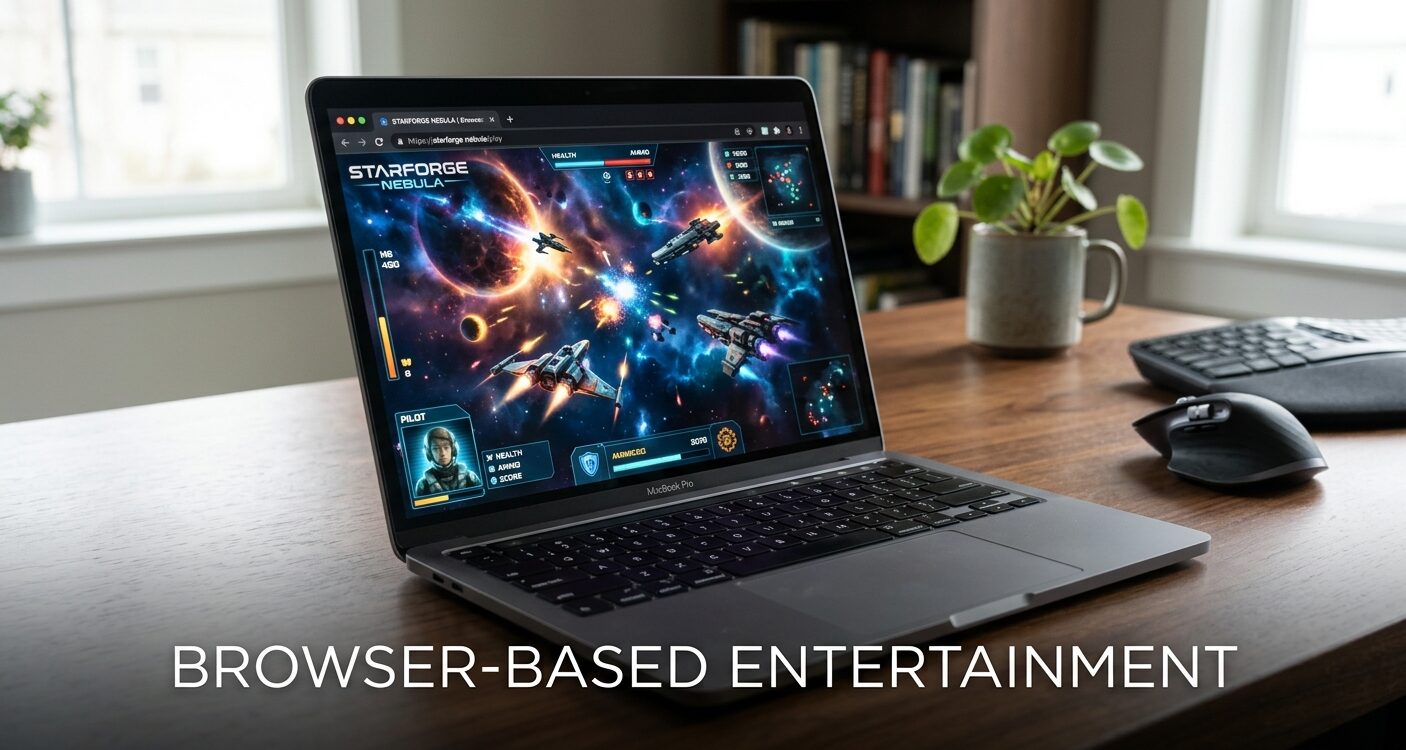
The technology finally caught up
Three developments made the difference. HTML5 replaced plug-ins like Flash, which Adobe stopped supporting at the end of 2020, giving every modern browser native support for video, audio and graphics.
WebAssembly, which became an official W3C web standard in 2019, lets code written in languages like C++ and Rust run in the browser at close to native speed.
And newer graphics interfaces such as WebGL and WebGPU give web pages direct access to the device’s GPU.
Together, these mean a game engine, a video editor or a 3D modelling tool can run in a tab with performance that would have required an installed program a decade ago. Our gaming section follows how that shift is changing the way games are built and played.
The results are visible well beyond gaming. Music producers sketch tracks in browser-based studios, designers collaborate on the same file in real time without installing anything, and video editors trim and export clips from a tab.
Each of these once required powerful local software. The browser has quietly become a capable creative workstation as well as a place to consume content.
Cloud streaming removes the hardware question
Cloud gaming pushes the idea further. Instead of running a game locally, services stream it from remote servers, so a browser on a modest laptop or phone can display titles that would never run on that hardware.
The player’s device only needs to handle video and input. For many genres, particularly turn-based and slower-paced games, the experience is now close enough to local play that most people do not notice the difference.
Instant access changes behaviour
The biggest effect is on behaviour, not technology. When something loads from a link in a few seconds, people try it. When it requires a download, an account and an update, many do not bother. Browser games have always had this advantage, and it now applies to much richer experiences.
Progressive web apps blur the line further, letting a website sit on a home screen, send notifications and work offline like a native app.
That accessibility is attractive to developers too. A single web build reaches every platform, updates instantly for every user and avoids app store review queues and commission fees.
Casino-style entertainment in the browser
Online casino-style games were among the first to commit fully to the browser. Social casino and sweepstakes platforms in the US run almost entirely on the web, with lobbies of slots and table games that load in seconds on any device.
Many use two virtual currencies: Gold Coins, which are for play only and carry no cash value, and a promotional currency usually called Sweeps Coins, which can be redeemed for prizes on sweepstakes platforms once players meet the terms.
ACE is one example of a platform built around Gold Coins and casino sweep coins, with free coins handed out through daily bonuses and promotions so that no purchase is required to play.
The browser model makes these platforms easy to reach, which is also why regulation has followed closely. Sweepstakes casinos have been banned or restricted in several US states during 2026, including California, and availability varies from state to state. Anyone interested should check eligibility and read the terms before signing up.
The trade-offs
Browser-based entertainment is not without downsides. Performance still depends on connection quality, and a dropped signal can interrupt a session in a way an installed game would not. Privacy deserves attention, since web platforms can collect a lot of data through cookies and trackers.
And the ease of access that makes the browser so appealing also makes it easier to slip into longer sessions than planned.
Browser extensions that set time limits, and the screen-time tools built into most operating systems, help keep that in check.
Quality varies, too. The same openness that lets anyone publish a great web game also lets anyone publish a poor or untrustworthy one.
Sticking to established platforms and checking who operates a site before entering personal details is basic good practice.
The browser as the default
The direction is clear. As web standards mature and cloud infrastructure improves, more entertainment will start in a browser tab rather than an app store.
For users, that means faster access and fewer barriers. For developers, it means one platform that reaches everyone.
The challenge is to keep the convenience while bringing the same care about privacy, quality and healthy habits that we expect from anything else we use every day.
